


Further commencements on 13 March 2026, this Amendment Act enhances the vibrancy of the night-time economy in New South Wales, particularly by focusing on live music venues, entertainment precincts, and dispute resolution mechanisms.
Commenced on 27 February 2026, this Regulation has been made under the Children (Education and Care Services National Law Application) Act 2010 (NSW) to modify the application of certain provisions of the Education and Care Services National Regulations in New South Wales and to apply amendments to the Education and Care Services National Law in the state.
Commenced on 4 March 2026, these Rules establish mandatory security standards for consumer-grade smart devices that connect to the internet, excluding desktop computers, laptops, tablet computers, smartphones, therapeutic goods, and road vehicles.
Commenced on 1 March 2026, the Regulations amend the Emergency Management Regulations 2006 (WA) to incorporate cybersecurity incidents as a hazard under the emergency management framework and establish the Department of the Premier and Cabinet as the hazard management agency for cybersecurity incidents.
Commenced on 23 February 2026, this Amendment Act amends several ACT laws relating to justice and community safety to ensure they meet high standards, support the practical operations of justice sector agencies, and better protect the ACT community.
Partially commenced on 11 March 2026, this Amendment Act amends several local government legislation to enhance the autonomy and operational effectiveness of local governments in Queensland.
Commenced on 1 February 2026, this Amendment Act amends various instruments to modernise the regulatory framework for the Queensland Building and Construction Commission (QBCC), support the QBCC's transition to digital service delivery, and streamline workplace safety notifications to improve productivity in Queensland's building and construction industry.
Partially commenced on 19 February 2026, this Act establishes a framework for coordinating, facilitating and promoting development and activities of strategic or economic significance to Western Australia, creates the office of Coordinator General, and provides mechanisms for managing State-significant development projects while considering social and environmental factors.
Commenced on 10 February 2026, this Amendment Act amends several Northern Territory legislation to remove unnecessary regulatory and administrative burdens by standardising licensing processes, modernising outdated provisions, and streamlining administrative procedures.
Further commencements on 16 March 2026, this Amendment Act amends the Bus Safety Act 2009 (Vic), the Commercial Passenger Vehicle Industry Act 2017 (Vic) and the Transport (Compliance and Miscellaneous) Act 1983 (Vic) to enhance safety, compliance, and regulatory oversight in Victoria's transport sector.
Commenced on 14 March 2026, these Regulations revoke and replace the Trustee Companies Regulations 2016 (Vic) and prescribe matters required under the Trustee Companies Act 1984 (Vic).
Fully commenced on 27 February 2026, these Amendment Regulations amend the Worker Screening Regulations 2021 (Vic) to update references from the Secretary to the Social Services Regulator, prescribe additional relevant disciplinary or regulatory findings for the purposes of certain sections of the Worker Screening Act 2020 (Vic), and revoke the provision concerning prescribed persons.
Partially commenced on 11 February 2026, this Amendment Act amends the Workers Compensation Act 1987 (NSW), the Workplace Injury Management and Workers Compensation Act 1998 (NSW), the Personal Injury Commission Act 2020 (NSW), the Work Health and Safety Act 2011 (NSW), and other related legislation to implement reforms to and modernise the operation of the workers compensation scheme.
ASIC has issued an updated Regulatory Guide 168 to clarify and consolidate requirements for Product Disclosure Statements and related disclosure obligations, setting out content standards, product‑specific disclosure regimes, key compliance risks, and principles for clear, effective disclosure, as well as outlining lodgement and notification obligations for product issuers and AFS licensees under the Corporations Act 2001.
ASIC has released an updated Regulatory Guide 181 to clarify and strengthen expectations for Australian financial services licensees in managing conflicts of interest, confirming the breadth of the conflicts management obligation under the Corporations Act 2001, outlining what constitutes adequate and effective arrangements, and highlighting ASIC’s enforcement approach where conflicts are not properly identified, managed, or disclosed.
Further commencements on 1 January 2026, this Act establishes child safe standards and a reportable conduct scheme to promote and protect the rights, interests, and wellbeing of children in Queensland and amends the Evidence Act 1977 (Qld), the Family and Child Commission Act 2014 (Qld), and the Working with Children (Risk Management and Screening) Act 2000 (Qld).
Fully commenced on 16 March 2026, this Amendment Act amends the Crimes Act 1958 (Vic), the Summary Offences Act 1966 (Vic) and the Youth Justice Act 2024 (Vic) to introduce new criminal offences targeting conduct directed at workers in the retail, fast food, hospitality and passenger transport industries, and to expand the definition of aggravated burglary to capture ram raids.
Fully commenced on 1 January 2026, this Amendment Act amends the Domestic and Family Violence Protection Act 2012 (Qld), among others, to make significant changes to Queensland's domestic and family violence legislative framework by improving police responses to domestic violence incidents, enhancing protections for victims, and implementing the Government's election commitment for electronic monitoring of high-risk domestic violence offenders.
Commenced on 1 January 2026, this Amendment Regulation amends the Education and Care Services Regulation 2013 (Qld) to remove provisions relating to rest periods in education and care services and to streamline the regulatory framework by eliminating separate requirements for educator to child ratios during rest periods.
Fully commenced on 1 January 2026, these Regulations amend electricity and gas Regulations to introduce changes to penalties for contraventions of market rules, extend certain deadlines, and provide additional powers to the Minister.
Fully commenced on 1 January 2026, this Act makes consequential amendments to align legislation with the new Guarantee of Origin scheme established under the Future Made in Australia (Guarantee of Origin Act) 2024 (Cth), forming part of Acts package to establish a framework for tracking and verifying attributes of low-emissions products and renewable electricity, starting with hydrogen and providing an enduring certification mechanism for renewable electricity.
Commenced on 1 January 2026, this Amendment Code amends the Gas Marketing Code of Conduct 2022 (WA) to introduce new requirements for gas retailers and gas marketing agents, particularly regarding comparative marketing claims and basic plan information documents.
Partially commenced on 1 January 2026, this Amendment Act amends multiple transport-related Acts to enhance road safety, improve port management, strengthen marine safety provisions, and reorganise investigatory powers for transport safety matters.
Further commencements on 1 January 2026, this Amendment Act amends multiple pieces of legislation to reform taxation arrangements, modify exemptions, and update regulatory requirements in Victoria.
Commencing 1 July 2026, the regulations amend Australia’s superannuation framework to align superannuation guarantee contributions with each payday, replace quarterly payment obligations with a 7‑business‑day payment requirement, and modernise employer and superannuation fund compliance, processing timeframes, and penalty settings across the superannuation system.
Partially commenced on 1 January 2026, this Act provides significant amendments to various Treasury portfolio legislation, with a particular focus on enhancing corporate transparency, strengthening financial systems, and providing support for small businesses.
Commenced on 16 March 2026, this Amendment Act amends the Fair Trading Act 1986 (NZ) to introduce new requirements relating to gift card expiry dates, ensuring gift cards remain valid for a reasonable period and that expiry information is clearly communicated to consumers.
Further commencement on 1 February 2026, this Act amends the Income Tax Act 2007 (NZ), the KiwiSaver Act 2006 (NZ), and the Tax Administration Act 1994 (NZ) to introduce Investment Boost, a partial expensing regime to lift capital investment, help increase productivity, and facilitate economic growth, and to give effect to several changes to the KiwiSaver regime.
Commenced on 15 January 2026, these Amendment Regulations amend the Resource Management (National Environmental Standards for Freshwater) Regulations 2020 (NZ) to expand the scope of discretionary activities in relation to freshwater management.
Partially commenced on 1 July 2025, this Act establishes a comprehensive framework for the licensing, regulation, and prudential supervision of deposit takers, including banks and other persons in the business of borrowing and lending money.
Commenced on 1 July 2025, these Regulations revoke and replace replaces the Gambling (Problem Gambling Levy) Regulations 2022 (NZ) to establish a new problem gambling levy framework.
Commenced on 1 July 2025, these Regulations establish requirements for the depositor compensation scheme (DCS), which protects deposits up to $100,000 per depositor in the event of a deposit taker failing, and prescribe the levy payable by licensed deposit takers to meet the costs of the DCS under the Deposit Takers Act 2023 (NZ).
Fully commenced on 1 July 2025, this Amendment Act introduces a range of amendments to various Acts relating to immigration and workforce matters.
Commenced on 1 July 2025, this Amendment Act amends the Employment Relations Act 2000 (NZ) to enable the employers to make specified pay deductions when employees engage in partial strikes and makes consequential amendments to the Wages Protection Act 1983 (NZ) and the Education and Training Act 2020 (NZ).
Commenced on 1 July 2025, these Amendment Regulations amend the Employment Court Regulations 2000 (NZ) to increase the fees relating to proceedings in the Employment Court by 3.65%.
Commenced on 1 November 2025, this Notice amends the Anti-Money Laundering and Countering Financing of Terrorism (Class Exemptions) Notice 2018 (NZ) to introduce exemptions for reporting entities that are approved participants in the Fraud Intelligence Exchange Ecosystem.
Commenced on 13 November 2025, these Regulations amend the Gas (Safety and Measurement) Regulations 2010 (NZ) to incorporate updated New Zealand and international standards and update the bodies that may certify gas appliances and fittings.
Commenced on 13 November 2025, these Regulations amend the Electrical (Safety) Regulations 2010 (NZ) to incorporate updated New Zealand and international standards and to address recent technological developments and to increase the permitted voltage fluctuation range for electricity supply.

The module supports WA Non-Government Schools, primarily addresses the registration standards, schools and educations funding requirements, and the education of overseas students.
A new mini module has been launched to provide coverage of public sector superannuation in relation to Public Sector Superannuation Reform Regulations 2017 (Tas), specifically covering:
- Superannuation Commission (Tas) scheme obligations
- Functions and duties of the Superannuation Commission
- Contributions and membership entitlements
- Calculating and paying tax
- Paying benefits and lump sums
- Managing TASS, SFCS and Parliamentary schemes
- Reporting
The Queensland Mining module provides mining organisations with information on how to comply with legal responsibilities relating to obtaining licences and leases, land access, WHS, mine inspections and transportation of mined resources as well as financial reporting and foreign investment. It also covers the requirements for mining licences and leases, including Aboriginal heritage, native title, environmental protections and water monitoring. Whether the organisation has surface or underground operations, or has onshore or offshore functions, the Queensland Mining module provides support for its effective compliance management.
NSW Local Government is comprised of nine submodules addressing the specific requirements of council responsibility, including: governance, administration and integrity; finance; roads and infrastructure; land use, planning and development; public lands and property; public health and other community services; water, waste and environment; business and economic development; and events and recreation. Its coverage forms a comprehensive compliance framework for local and county councils; mayors, councillors and general managers; senior governance, finance, planning and environmental officers as well as compliance and risk managers responsible for council service delivery and regulatory functions.

The Australian aged care framework has undergone significant reform following the introduction of the Aged Care Act 2024 (Cth) and Aged Care Rules 2025 (Cth), establishing a consolidated, rights-based system for the delivery and regulation of aged care services. Key changes include strengthened provider registration requirements, expanded regulatory and enforcement powers, and a clearer legislative focus on embedding the rights of older people within care delivery. The updated framework also reflects a more structured and transparent approach to regulation, supporting providers to align with enhanced compliance expectations and improved standards of care.
Consequently, we published a new Registered Aged Care Providers register to coincide with the November 2025 rollout of the Aged Care Act 2024 and the Aged Care Rules 2025. The scale of these reforms rendered much of the material in the Home Care and Residential Care modules outdated. We have already incorporated many updates into the new register.
Updates to the National Scheme regulating Australia’s 15 registered health professions, aimed at improving effectiveness and responding to evolving health system needs. One key reform is that where a tribunal makes a finding of professional misconduct based on sexual misconduct, that information will be permanently recorded on the public register. This change will apply retrospectively and commence in April 2026.
Legislative developments flowed from the 2025-26 Federal Budget, which included funding measures to improve healthcare accessibility and affordability. These include bulk-billing reforms for GP services, such as a 60% increase in consultation payments and expanded bulk-billing incentives. These changes are significant for organisations operating GP health services.
The Regulatory Reform Omnibus Act 2025 (Cth) streamlines and modernises a broad range of Commonwealth regulations. Its amendments include measures to support greater cross-agency information sharing, digital identity checks, longer timeframes for some diagnostic imaging referrals, improved regulator and health data sharing, and the repeal of redundant legislation.
NSW Health is progressing significant regulatory reform, guided by the Future Health: Guiding the next decade of health care in NSW 2022–2032 report. These long-term priority projects focus on equity and patient-centred care, workforce analysis, prevention, the integration of research and innovation into care design and delivery, digital transformation, and strategies to address rising healthcare costs, growing demand, and the challenges of an ageing population.
A significant number of updates have impacted PBS pricing and listing decisions. These developments largely originate at the Commonwealth level, but flow through, where relevant, to the NSW Healthcare, Queensland Healthcare and Clinical Care, and Allied Health Services registers.
We added new material on the Strengthened Aged Care Quality Standards, which now set the national benchmark for safe, quality aged care. Together with the Aged Care Act 2024, these standards replaced the previous framework after the Royal Commission identified gaps in dementia care, diversity, governance, food and nutrition, and clinical care.
The updated standards are more detailed, measurable, and rights-based. Each of the seven standards includes an intent statement, a first-person expectation statement for older people, enforceable outcome statements, and actions showing how providers can meet those outcomes. The framework contains 33 outcomes and 154 supporting actions, with providers assessed at the outcome level.
The new material also explains that providers in registration categories 1 to 3 are not subject to the Strengthened Quality Standards, although they must still comply with the Statement of Rights and the Aged Care Code of Conduct. Category 4 providers are assessed mainly against Standards 1 to 4, category 5 providers against Standards 1 to 5, and category 6 residential providers against all Standards 1 to 7.
We have commissioned further content to strengthen the Registered Aged Care Providers register. This includes a new aged care obligation on client capacity in Australia across residential and home care.
The material will need to be updated to reflect any future changes to state and territory consent, capacity, and guardianship laws as they apply to registered aged care providers. We currently have material for NSW, Queensland, South Australia, and Victoria, but a fully developed Registered Aged Care Providers module will also need to cover Tasmania, Western Australia, the ACT, and the Northern Territory.
This new content will provide guidance on dignity and choice, respect, informed decision-making, responding to individual needs, capacity toolkits, consent to health treatment, improved health records, the requirements under the new Aged Care Act and Rules, and the key state and territory laws relating to consent and guardianship.
New material on the Veterans’ Home Care Scheme (VHC) assessment process. While we already cover the Single Assessment pathway, which is the main aged care entry pathway, the VHC assessment process remains a DVA-specific pathway that complements the national aged care system.
Our upcoming update will cover this DVA-specific pathway, including VHC eligibility and needs-based assessment, the VHC Care Plan, and ongoing periodic assessments.
We plan to update our content on the National Disability Insurance Scheme (NDIS) to reflect a major review of the rules and recent legislative instruments that have produced a broader and more interconnected legislative framework.
The AML/CTF module has been significantly updated ahead of the amendments taking effect on 31 March 2026, introducing a broad suite of new and revised obligations across customer due diligence, reporting, record-keeping, and cross-border transactions. Key changes include tighter conditions for customer verification and enhanced ongoing monitoring requirements, strengthened governance expectations at both group and board level, and the introduction of new enrolment and annual attestation requirements for higher-risk sectors. While expanded reporting data requirements have been incorporated, some elements will be deferred until 2029. The updated framework also delivers clearer structure and usability, with future obligations separated from current requirements, legacy provisions archived, and enhanced guidance provided across emerging compliance areas.
Overall, the changes reflect a more prescriptive, risk-based and transparent AML/CTF regime, supporting reporting entities to better prepare for and implement the forthcoming regulatory reforms.
The Digital Transformation Agency (DTA) has developed a policy for the responsible use of AI in Government. The policy applies to all non-corporate Commonwealth entities (with some exceptions). The purpose of the policy is to strengthen the government's approach to safe and responsible AI through mandatory obligations relating to AI governance. The core obligation and four sub-obligations have been captured to assist in outlining the mandatory requirements agencies must follow.
From 1 July 2026, new regulations will introduce changes to Australia’s superannuation framework. The reforms apply to employers across the superannuation system and are designed to strengthen the alignment between superannuation guarantee contributions and employee pay cycles. The measures replace quarterly contribution requirements with a mandatory payment timeframe of seven business days following each payday, and modernise employer and superannuation fund compliance arrangements. Updated processing timeframes and penalty settings have also been introduced to support more timely payments and improved system integrity.
A new obligation has been added to address the Depositor Compensation Scheme that applies from 1 July 2025

- Editorial, data integrity, and stylistic updates will be omitted
- Obligation titles will be included to assist with searching and navigation
- Registered Aged Care Providers compliance register will be the primary repository of all aged care content in the foreseeable future.
- Retirement Villages compliance register will continue to be updated as it is governed by state law rather than the new Commonwealth aged care regulatory reforms.


Ethical AI in the Workplace: Reducing Workload, Improving Efficiency, and Managing Risks
AI is transforming how organisations hire, develop, and support their people by reducing workload, improving efficiency, and streamlining HR processes. But with that power comes real ethical and compliance risks.
Our new blog breaks down what Australian leaders need to know to innovate responsibly.

Australia’s AML/CTF regime: What’s changed and what’s coming in 2026?
Australia’s AML/CTF regime is undergoing its biggest transformation in nearly 20 years, and the changes are already underway. If you handle customer funds, transfer value, or provide professional advisory services, these reforms are essential reading.
From the repeal of the Financial Transaction Reports Act and updated tipping-off laws in 2025, to sweeping reforms taking effect in March and July 2026, the new framework will impact banks, digital asset providers, and for the first time, lawyers, accountants, real estate professionals, and other high-risk sectors.
Our latest blog breaks down what’s changed, what’s coming, and what your business needs to do now to stay compliant. Access today and download a free AML-CTF checklist to assess your readiness, close compliance gaps, and prepare confidently for the 2026 reforms.

New Zealand’s Privacy Shake-Up: Why IPP3A is a bigger deal than it sounds.
New privacy rules are coming, and they’re bigger than they sound. From May 2026, IPP3A will require organisations to notify individuals when their personal information is collected indirectly. If you source data from third parties, public registers, referees, or purchased lists, this change directly impacts you.
IPP3A is more than a technical amendment; it signals a shift from silent data processing to visible governance. Transparency is no longer optional.
Read the blog to understand what’s changing, what it means for your organisation, and download your free IPP3A checklist to start preparing today.
Ethical AI in the Workplace: Reducing Workload, Improving Efficiency, and Managing Risks
AI is transforming how organisations hire, develop, and support their people by reducing workload, improving efficiency, and streamlining HR processes. But with that power comes real ethical and compliance risks.
Our new blog breaks down what New Zealand leaders need to know to innovate responsibly.

Australian Employment Checklist
Authored by Dominic Fleeton, Partner at K&L Gates, this practical tool is built from the trusted content of the Australian Employment Compliance Register by LexisNexis® Regulatory Compliance. It distils complex Commonwealth, state, and territory employment obligations into clear, actionable steps, helping employers confidently meet their legal responsibilities.
This checklist provides guidance and supports organisations in implementing the procedures and processes needed to maintain strong compliance and regulatory accountability at every level.
Australian AML-CTF Checklist
AML/CTF continues to dominate global headlines, and in Australia, the landscape is undergoing significant change with the introduction of Tranche 2 reforms. These reforms expand AML/CTF obligations beyond traditional financial services to newly regulated sectors, including lawyers, accountants, real estate professionals, trust and company service providers, and dealers in precious metals and stones.
This AML/CTF compliance checklist is designed to help both existing reporting entities and newly regulated businesses navigate their requirements under the updated regime. It covers key areas including governance, enrolment and registration with AUSTRAC, customer due diligence, suspicious matter reporting, and ongoing compliance obligations, and more.
New Zealand Employment Checklist
Our New Zealand Employment compliance checklist provides you with guidance on your compliance obligations, to ensure your business is meeting its employment requirements from good faith principles and collective bargaining to privacy/record keeping and business restructures, and more!
Content is taken from the Employment Compliance Register, part of our Core Modules Suite that includes: Anti-Bribery & Corruption, Company Law, Consumer Law, Environment, Privacy & Data Protection, Tax and Workplace Health & Safety.
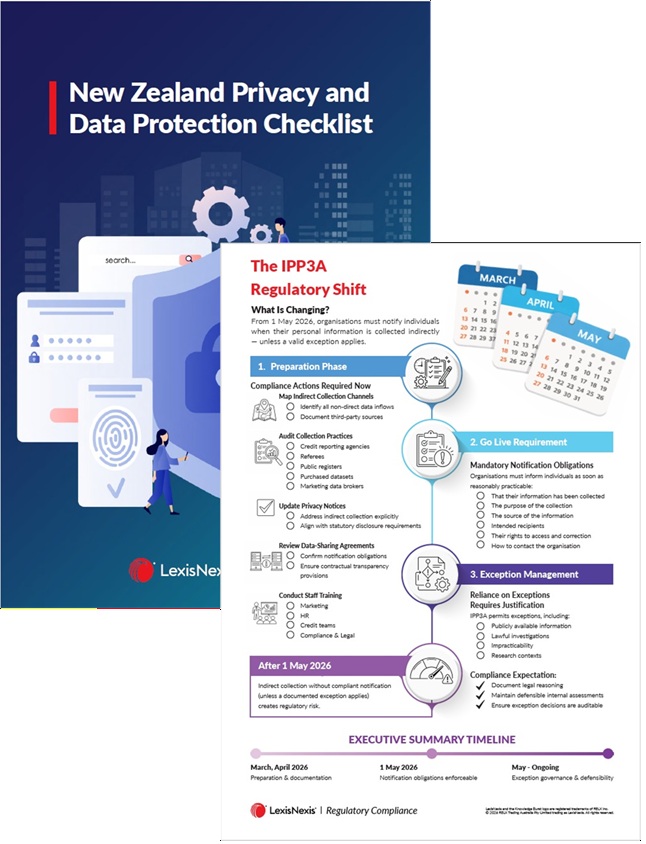
New Zealand Privacy & Data Protection Checklist and IPP3A Infographic
New privacy rules are coming, and they’re more significant than they first appear. From May 2026, IPP3A will require organisations to notify individuals when their personal information is collected indirectly. If your business relies on third-party data sources, public registers, referees, or purchased lists, this change directly affects how you operate.
This isn’t just a technical update, it’s a shift toward greater transparency and accountability. Organisations will need clear governance structures in place to demonstrate compliance and build trust. To help you get ahead, LexisNexis Regulatory Compliance has developed a practical, IPP3A checklist built into our Privacy & Data Security checklist.
Download yours today and take the first step toward confident, compliant data practices.


Alana Scheiffers
Management and Governance Consultant/ Principle-Owner
ASK Consultancy and Advisory
Alana Scheiffers is a governance and regulatory compliance expert with more than two decades’ experience advising within complex, highly regulated public sector environments. She brings deep expertise across statutory interpretation, enterprise compliance frameworks, administrative law, and public sector accountability.
Alana has held senior executive roles at Commonwealth Superannuation Corporation, including as General Counsel, Company Secretary, and Executive leader of legal, compliance, governance, and parliamentary engagement functions. In these roles, she advised boards and executives on the application of legislative and regulatory obligations, led enterprise-wide compliance systems, and managed strategic relationships with key regulators and government stakeholders. Her experience includes appearing before parliamentary inquiries, supporting ministerial engagement, and overseeing internal review and dispute resolution processes.
Through her consultancy, Alana works with public, private, and not-for-profit organisations to design and implement fit-for-purpose governance and compliance frameworks. Her work focuses on translating complex legal and regulatory requirements into practical, operational systems that support effective decision-making, accountability, and organisational performance.
Alana also contributes as a Subject Matter Expert to LexisNexis, providing practitioner insight to ensure legal and regulatory content reflects real-world application, particularly in public sector and statutory contexts. Her areas of focus include regulatory compliance, governance systems, integrity frameworks, and administrative decision-making.
She holds a Master of Business Administration, a Bachelor of Laws (Honours), and is a Graduate of the Australian Institute of Company Directors.

SAI360
Specialises in integrated risk, ethics, and compliance management with a strong focus on culture and conduct.

Riskware (Pan Software)
Provides flexible, configurable risk and compliance tools designed for operational efficiency and scalability.

Amstelveen
Offers advanced governance and audit solutions with a focus on financial controls and assurance.

Skefto
Brings innovative, user-centric risk management technology with strong analytics and reporting capabilities.
ionMy (Thoughtware)
Focuses on intelligent risk and compliance solutions that leverage automation and data-driven insights.



Artificial intelligence is transforming business and revolutionising industries in ways we've never seen before. From powering voice assistants like Siri and Alexa to advancing healthcare through innovative diagnosis tools, AI is analysing data, identifying patterns, and making decisions faster and more accurately than humans alone.
But with rapid advancement comes complex challenges. How do we ensure this powerful technology is deployed responsibly?
Find out in our latest whitepaper, Navigating the Challenges of AI Regulation. Discover the current state of AI regulation globally, proposed frameworks for developing ethical AI, and what the evolving regulatory environment means for your business.

AI-enabled monitoring, biometrics, and algorithmic management are reshaping today’s workplace, and with that shift comes a new compliance frontier. From privacy and data governance to bias, transparency, and employee trust, organisations must now navigate risks that didn’t exist a decade ago.
Our latest whitepaper, Building Safe & Smart AI Practices in the Workplace, unpacks what compliance professionals need to know to stay ahead of rapidly evolving regulatory and ethical expectations, and offers practical guidance backed by deep subject-matter expertise.

- What the amendments mean for your organisation
- Key compliance risks and civil penalty exposure
- Practical steps to update policies and reporting frameworks
- How to prepare for psychosocial hazard reporting in 2026
